

When beginners talk about eyelash extension sizes, they often mean lash length—such as 8mm, 10mm, or 12mm. In professional lash products, however, length is only one part of the sizing system.
A complete eyelash extension specification is primarily defined by three elements:
Length + Thickness + Curl
Each controls a different characteristic of the extension:
| Specification | What It Describes | What It Mainly Affects |
|---|---|---|
| Length | Length of the lash fiber | Visual length and projection |
| Thickness | Diameter of the fiber | Weight, flexibility and definition |
| Curl | Curvature of the extension | Lift, shape and overall appearance |
These specifications work together rather than independently. Two extensions with the same length can produce very different results when their thickness or curl is different.
For Volume and other structured lash products, additional specifications may also appear, such as fan dimension (2D, 5D, 10D) or product structure. These describe how multiple fibers are arranged rather than replacing the three basic size specifications.
Most importantly, the size printed on a lash tray is a nominal specification. It tells you the intended length, diameter, and curl, but it does not describe every characteristic of the finished extension. Fiber taper, cross-sectional shape, product structure, and manufacturing consistency can also influence how a lash actually looks and performs.
Understanding this distinction is the first step to reading an eyelash extension size correctly.
At first glance, an eyelash extension tray can contain several letters and numbers, but the basic size information is easy to identify once you know what each format represents.
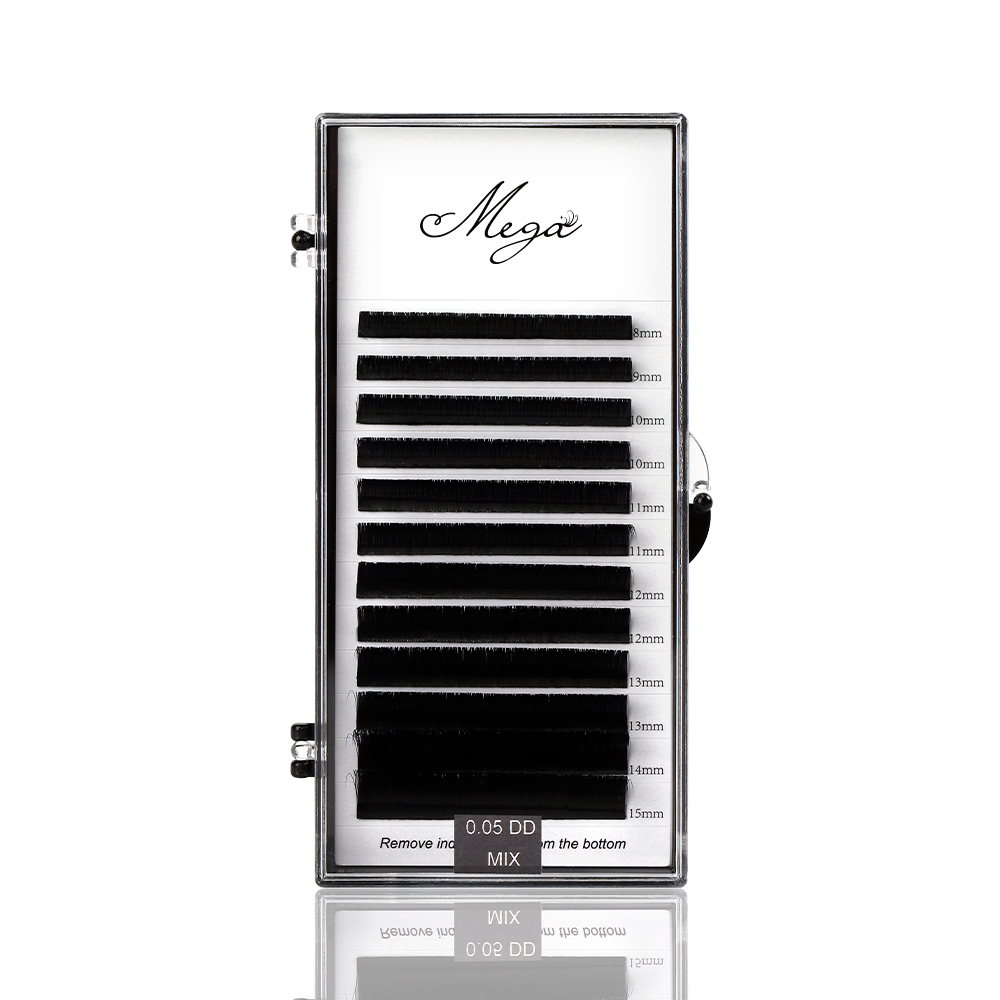
A simple way for beginners to read lash extension sizes is:
Letters = Curl | Decimal numbers = Thickness | Millimeter numbers = Length
For example:
C Curl · 0.07mm · 12mm
means:
C Curl – the curvature of the lash extension
0.07mm – the diameter or thickness of the lash fiber
12mm – the length of the lash extension
Lash extension curls are normally represented by letters, such as:
J, B, C, CC, D, L, M
These letters describe different curl profiles rather than lash length or thickness. For example, a tray labeled C / 0.07 / 12mm uses a C Curl.
The exact curvature represented by the same curl letter can vary slightly between manufacturers, so curl letters should be treated as product classifications rather than universal geometric measurements.
Lash fiber thickness is usually expressed as a decimal measurement in millimeters because an individual extension fiber is less than 1mm in diameter.
Common examples include:
0.03mm, 0.05mm, 0.07mm, 0.10mm, 0.12mm and 0.15mm
Therefore, when you see 0.07 or 0.15 on a lash extension tray, it usually refers to the fiber diameter, not the lash length.
For example:
D / 0.05 / 13mm
Here, 0.05mm is the thickness.
Lash extension length is also measured in millimeters, but unlike thickness, it is normally shown as a larger number such as:
6mm, 8mm, 10mm, 12mm, 15mm or 18mm
So in:
C / 0.07 / 12mm
12mm is the lash length.
Some trays contain only one length, while others contain several lengths in the same tray.
MIX means that multiple lash lengths are included in one tray.
For example:
C Curl · 0.07mm · 8–15mm MIX
indicates that the tray contains C Curl lashes with a 0.07mm fiber diameter and multiple lengths between 8mm and 15mm.
A single-length tray, by comparison, contains the same lash length across the tray, such as:
C Curl · 0.07mm · 12mm
Mixed trays are useful when several lengths are needed to create a lash set or lash map without purchasing a separate tray for every size.
However, not every MIX tray contains the same length combination or the same number of rows for each length. One mixed tray may focus more heavily on shorter lengths, while another may include more rows of commonly used middle lengths. The exact MIX configuration depends on the product and manufacturer.
For lash brands and professional buyers, mixed-length trays can also be configured around different target lash styles, application habits, and market preferences.
Some lash products, especially premade fans, include another number followed by D, such as 5D or 10D.
This does not describe lash length or thickness.
For premade fans:
10D = 10 individual fibers arranged into one fan
For example:
D Curl · 0.05mm · 12mm · 10D
means:
D Curl + 0.05mm fiber thickness + 12mm length + 10-fiber premade fan
Once these formats are understood, most professional lash extension size labels become much easier to read:
Letter → Curl
0.xx mm → Thickness
Larger mm number → Length
MIX → Multiple lengths in one tray
xD → Number of fibers in a volume fan
Eyelash extensions are available in many combinations of length, thickness, and curl. The chart below provides a quick overview of the common size ranges used across professional lash products.
| Size Category | Common Sizes | General Description |
|---|---|---|
| Length | 5–8mm | Short |
| 9–11mm | Medium-short | |
| 12–14mm | Medium to long | |
| 15–17mm | Long | |
| 18–20mm+ | Extra-long / specialty lengths | |
| Thickness | 0.03–0.05mm | Ultra-fine |
| 0.07mm | Fine | |
| 0.10–0.12mm | Medium | |
| 0.15mm | Defined | |
| 0.20–0.25mm | Heavy / limited-use diameters | |
| Curl | J / B | Soft curvature |
| C / CC | Medium to strong curvature | |
| D / DD | Strong curvature | |
| L / LC / LD | Straight-base specialty profiles | |
| M | Lifted specialty profile |
This eyelash extension size chart is a reference rather than a universal sizing standard. Manufacturers may offer additional lengths, diameters, or curl profiles, and the same labeled size does not always produce an identical finished lash across different product ranges.
For example, 12mm identifies the nominal fiber length, but a 12mm C Curl and a 12mm D Curl can appear different once their curvature is taken into account. Likewise, 0.15mm identifies nominal fiber diameter, but a round lash and a flat lash with the same labeled thickness can differ in cross-sectional shape, weight, and visual width.
For beginners, the important point is not to memorize every available size. Start by understanding the three specifications separately—length determines how long the extension is, thickness describes the fiber diameter, and curl determines its curvature. The following sections look at each one in more detail.
Lash extension length refers to the nominal length of the extension fiber and is measured in millimeters (mm). Professional eyelash extensions are commonly available from short lengths around 5–8mm to longer sizes of 18–20mm or more, depending on the product range.
Unlike thickness, lash length is normally shown as a whole-number millimeter measurement on the tray, such as 8mm, 10mm, 12mm, or 15mm.
Common Lash Extension Lengths
| Length Range | General Category | Typical Visual Role |
|---|---|---|
| 5–8mm | Short | Subtle length and shorter areas of a lash map |
| 9–11mm | Medium-short | Natural-looking transitions and moderate length |
| 12–14mm | Medium to long | More noticeable length and definition |
| 15–17mm | Long | Elongated and more dramatic effects |
| 18–20mm+ | Extra-long | Bold or specialized lash designs |
These categories are only general references. A 12mm lash is not automatically a “medium” lash for every client or lash design. Its appearance depends on the natural lashes, eye shape, surrounding lengths, curl, and the overall lash map.
One important detail is often missed in basic lash size charts: lash extension length refers to the length of the fiber itself, not simply its visible height when viewed from the front.
Lash extension thickness refers to the diameter of an individual extension fiber and is measured in millimeters (mm). Because lash fibers are extremely fine, thickness is normally expressed as a decimal number such as 0.03mm, 0.07mm, 0.10mm, or 0.15mm.
In general, thinner fibers are lighter and more flexible, while increasing the diameter makes an individual fiber heavier, firmer, and visually more defined.
Because lash extensions are curved, the fiber follows an arc from the base to the tip. This means fiber length and apparent length are not always the same thing.
For example, two extensions may both be labeled 12mm, but if one has a C Curl and the other has a stronger D Curl, their tips can sit at different positions when the bases are aligned.
Therefore:
Same nominal length ≠ same visual projection
This becomes especially important when comparing lashes with substantially different curl profiles.
Professional lash sets rarely rely on a single length across the entire eye. Different lash extension sizes are usually combined to create transitions, shape, and proportion.
For example, a lash map may gradually move through several lengths:
8mm → 9mm → 10mm → 11mm → 12mm → 11mm
Another design may use a wider range of sizes to create a more elongated or textured effect.
This is also why MIX trays are useful: they provide several lash lengths within one tray, allowing different sizes to be combined without requiring a separate tray for every length.
The right lash extension length should therefore be considered as part of a complete sizing system rather than selected in isolation. Length works together with thickness, curl, natural lash condition, and lash mapping to determine the final result.
| Thickness | General Category | Fiber Characteristics |
|---|---|---|
| 0.03mm | Ultra-fine | Extremely light and flexible |
| 0.05mm | Very fine | Very light with soft flexibility |
| 0.07mm | Fine | Light with more noticeable structure |
| 0.10mm | Medium | Balanced firmness and definition |
| 0.12mm | Medium | Firmer with stronger definition |
| 0.15mm | Defined | More substantial and visibly defined |
| 0.20–0.25mm | Heavy | Heavier, firmer and less flexible |
These ranges are practical references rather than fixed application rules. The appropriate thickness also depends on extension length, number of fibers, natural lash condition, and product structure.
The difference between 0.05mm and 0.07mm may look insignificant on a tray label, but lash diameter does not increase in a simple one-to-one relationship with the amount of fiber material.
For round fibers of the same material and length, increasing the diameter increases the cross-sectional area and therefore the approximate fiber weight. This is one reason ultra-fine diameters can be combined into Volume fans while thicker fibers are more commonly used individually.
In practical terms:
0.03–0.05mm → finer, lighter and more flexible
0.07mm → lightweight with more structure
0.10–0.15mm → progressively more defined and firm
This is why a difference of only 0.02mm or 0.03mm can noticeably change how an extension behaves.
Not always.
A thickness such as 0.15mm describes the nominal fiber diameter, but it does not fully describe the amount or distribution of material in the finished extension.
For example, a traditional round lash and a flat lash may both be labeled 0.15mm, but their cross-sectional shapes are different. As a result, they can differ in weight, flexibility, bonding surface, and visual width.
The same principle applies when comparing an individual lash with structured products such as premade fans, YY lashes, or W lashes. The listed thickness may describe each individual fiber, while the complete lash unit contains multiple fibers or tips.
Therefore:
Same nominal thickness ≠ same total lash weight or structure
For beginners, thickness should be used as an important sizing reference, but not as the only indicator of how heavy, soft, or full an eyelash extension will be.
For a more detailed comparison of individual diameters, their weight relationships, and their use in Classic, Volume, and Mega Volume techniques, see our Lash Extension Thickness Guide.
Lash extension curl describes the curvature and shape of an extension fiber. Unlike length and thickness, which are expressed in millimeters, curl is identified by letters such as J, B, C, CC, D, L, and M.
Curl is part of the overall eyelash extension size specification because changing the curvature can significantly affect how the same length appears once the lash is viewed or applied.
| Curl | General Profile | Visual Characteristic |
|---|---|---|
| J | Very soft curve | Subtle lift with a straighter appearance |
| B | Soft curve | Natural-looking curvature |
| C | Medium curve | Balanced, noticeable lift |
| CC | Medium-strong curve | More lifted than C |
| D / DD | Strong curve | Pronounced, dramatic lift |
| L / LC / LD | Straight-base specialty profiles | Straighter base with a more defined upward transition |
| M | Lifted specialty profile | Distinctive lifted shape with a flatter base area |
These descriptions are general references. Curl letters help distinguish different profiles within a lash range, but they should not be treated as exact universal measurements.
Two lash extensions can have the same nominal length but different curl profiles, causing them to look different when their bases are aligned.
For example:
12mm C Curl ≠ 12mm D Curl in visual projection
Both fibers may have a nominal length of 12mm, but the stronger curvature changes the direction and position of the lash tip. One may project farther outward, while the other creates more upward lift.
This is why lash length and curl should be considered together rather than reading the 12mm measurement alone.
Not exactly.
A C Curl from one manufacturer may not have precisely the same curvature as a C Curl from another manufacturer. Differences can result from the forming profile, fiber characteristics, heat-setting process, and the manufacturer's own curl specifications.
The same applies to specialty curls. Labels such as L, M, LC, or LD describe recognizable curl families, but their exact base length, transition point, and curvature can vary between product ranges.
Therefore:
Same curl letter ≠ identical curl geometry
For beginners, curl letters are best understood as a practical system for identifying and comparing lash profiles—not as universally fixed angles or curvature measurements.
When comparing different sizes of lash extensions, look at length, thickness, and curl together. For a detailed comparison of individual curl shapes and how each profile differs, see our Lash Extension Curl Types & Chart.
Two lash extensions can carry exactly the same size label and still look or perform differently.
For example, two products may both be labeled:
12mm · 0.07mm · C Curl
On paper, they have the same length, thickness, and curl. In practice, however, differences in taper, fiber shape, curl geometry, and product construction can create noticeably different extensions.
This is why lash size should be understood as a nominal specification rather than a complete description of the finished product.
An eyelash extension is not a cylinder with the same diameter from base to tip. The fiber gradually becomes finer toward the tip, creating a tapered, cone-like profile.
Two 0.07mm lashes can therefore have the same nominal diameter but different taper lengths.
A longer, finer taper can create a softer and lighter-looking tip, while a shorter taper leaves more material along the fiber and can produce a darker, more defined appearance.
So:
Same diameter + different taper = different visual density and fiber profile
The number printed as thickness does not tell you the complete shape of the fiber.
A traditional individual extension generally has a round cross-section, while a flat lash has a flattened or elliptical profile.
Both products might be labeled 0.15mm, but the distribution of fiber material is different. This can change the lash's weight, frontal width, flexibility, and visual definition.
Therefore, thickness is most useful when comparing lashes with a similar fiber structure.
A curl letter identifies a curl category, but it does not define every part of the curve.
Two C Curl lashes may differ in:
Base curvature
Where the curve begins
Degree of lift
Overall arc
Tip direction
As a result, two lashes labeled 12mm · 0.07mm · C Curl may not align perfectly when placed side by side.
This difference can become even more noticeable when comparing specialty profiles such as L, M, LC, or LD curls.
The meaning of a size specification also depends on what kind of lash product is being measured.
For example, 0.07mm may describe the diameter of:
A single individual lash
Each fiber in a premade fan
Each fiber within a YY lash
Each fiber within a W lash
The nominal fiber thickness may be the same, but the complete lash units have very different structures and total amounts of fiber.
This is why:
Same size label does not always mean the same lash product.
When comparing eyelash extension sizes, the numbers on the tray are the starting point. To understand how the extension will actually look and perform, you also need to consider taper, cross-sectional shape, curl geometry, and product structure.
The numbers and letters printed on a lash tray describe the nominal size of the extension. They provide a standardized way to identify and order lash specifications, but they do not fully predict how the finished extension will look, feel, or perform.
For a typical individual lash:
Nominal Size = Length + Thickness + Curl
For example:
12mm · 0.07mm · C Curl
These specifications tell you the intended fiber length, diameter, and curl category. They are essential for identifying a product, but they are only the first layer of the specification.
For beginners, a more complete way to think about an eyelash extension is:
Nominal Size + Fiber Geometry + Product Structure = Actual Lash Characteristics
Nominal size provides the basic specification.
Fiber geometry includes characteristics such as the taper, cross-sectional shape, and actual curl profile.
Product structure describes whether those fibers form a single extension, flat lash, premade fan, YY lash, W lash, or another lash construction.
Together, these factors influence the characteristics that matter in actual use, including:
Weight
Flexibility
Visual width
Density
Lift and projection
Overall appearance
For example, choosing 0.07mm tells you the nominal diameter of a fiber. It does not automatically tell you how heavy the complete lash unit is. A 0.07mm individual extension and a 0.07mm multi-fiber lash structure are fundamentally different products.
Likewise, choosing 12mm tells you the nominal fiber length, but its apparent length can change with curl geometry.
This leads to one of the most important principles in this eyelash extension size guide:
Use size labels to identify and compare specifications, but use the complete lash construction to understand performance.
For beginners, this means you do not need to memorize every possible combination of lash extension sizes. First learn to read length, thickness, and curl, then consider how those specifications interact with the fiber and product structure.
The same size specification can mean something different once the structure of the lash product changes.
For a traditional individual lash extension, the size is relatively straightforward: the listed length, thickness, and curl describe a single extension fiber.
With structured lash products, however, several fibers or tips may form one complete lash unit. In these cases, the thickness printed on the tray usually describes the individual fiber, not the total size or weight of the finished structure.
| Lash Structure | What Thickness Refers To | Additional Structure to Consider |
|---|---|---|
| Individual Lash | Diameter of the single fiber | Fiber shape and taper |
| Flat Lash | Nominal thickness of the flat fiber | Flattened cross-section and fiber width |
| Premade Fan | Diameter of each fiber | Fan dimension, width, stem and base |
| YY Lash | Diameter of the fibers forming the YY structure | Split-tip / multi-tip structure |
| W Lash | Diameter of the fibers forming the W structure | Number and arrangement of connected fibers |
| U Lash | Diameter of the fibers forming the U structure | Number and arrangement of connected fibers |
This is why the thickness number should always be read together with the product type.
For a traditional round individual extension, a specification such as:
0.15mm · 12mm · C Curl
describes one round, tapered lash fiber.
A flat lash may carry the same 0.15mm · 12mm · C Curl specification, but its cross-section has been flattened to create a different fiber profile.
The nominal thickness may be the same, while the amount and distribution of material—and therefore the visual width, weight, and feel—can be different.
Premade fans introduce another important specification: fan dimension.
For example:
0.07mm · 12mm · C Curl · 5D
Here:
0.07mm = thickness of each individual fiber
12mm = length of the fibers
C Curl = curl profile
5D = five fibers forming one premade fan
The 5D does not make each fiber thicker. It describes how many individual fibers are assembled into the complete fan.
Two 0.07mm premade fans can therefore still be very different products if one is 3D and another is 10D.
Pre-shaped extensions such as YY, W, and U lashes also create additional density through their structure rather than simply using a thicker individual fiber.
For these products, a specification such as 0.07mm generally refers to the fibers used to form the lash structure. The complete extension contains multiple connected strands or tips arranged into a predefined shape.
As a result:
0.07mm Individual Lash ≠ 0.07mm Premade Fan ≠ 0.07mm YY or W Lash
The thickness number may describe a similar individual fiber diameter, but the complete lash unit has a different number of fibers, base construction, width, and visual density.
For standard individual extensions, length + thickness + curl provide most of the basic sizing information.
For structured lash products, a more useful way to read the specification is:
Length + Thickness + Curl + Product Structure
And for premade fans:
Length + Thickness + Curl + Fan Dimension + Fan Structure
This is why comparing lash extensions by a single number—such as 0.07mm—can be misleading. Always identify what that number is measuring and what kind of lash structure it belongs to before comparing two products.
Length, thickness, and curl are separate specifications, but they should not be selected independently. Changing one part of the lash size can change how the complete extension looks, weighs, and projects from the eye.
A useful way to understand eyelash extension sizing is:
Length controls how far the lash extends, thickness controls the fiber diameter, and curl controls the direction and curvature of that length.
The final result comes from the combination of all three.
Increasing from a 10mm to a 14mm extension does more than make the lash look longer. If the material, diameter, and structure remain the same, the longer fiber also contains more material.
This means that when significantly increasing length, the same thickness may not always produce the same overall balance.
For example:
10mm × 0.15mm × C
15mm × 0.15mm × C
Both use the same thickness and curl, but they should not be considered identical simply because two of the three specifications match.
Curl determines how the fiber's length is distributed between outward projection and upward lift.
For example:
12mm × 0.07mm × C
12mm × 0.07mm × D
Both have the same nominal length and thickness, but their different curvature changes the position of the tip and therefore how the 12mm length appears.
A stronger curl does not make the fiber itself shorter or longer—it changes how that length is shaped and visually presented.
Now compare:
12mm × 0.05mm × C
12mm × 0.15mm × C
The nominal length and curl are the same, but the difference in fiber diameter changes the weight, firmness, flexibility, and visual definition of the extension.
This becomes especially important when multiple fine fibers are combined into a Volume structure.
This is why there is no single “best lash extension size.” A 12mm lash is not inherently better than a 10mm lash, and 0.07mm is not inherently better than 0.10mm. Each specification only makes sense as part of the complete combination.
For beginners, instead of asking:
“What lash length should I use?”
it is more useful to think:
“What combination of length, thickness, and curl fits the intended lash design?”
For example, a lash set may use shorter and longer lengths across the eye, maintain one thickness, and combine compatible curls to create the intended shape. Another design may use finer fibers with a different structure to build more density without relying on thicker individual lashes.
The key principle is simple:
Do not choose length, thickness, or curl in isolation. Read and evaluate them as one complete eyelash extension size specification.
For beginners, choosing the right lash extension size becomes easier when the specifications are considered in the right order. Instead of selecting a length, thickness, or curl based only on appearance, start with the natural lashes and the type of lash set you want to create.
Before choosing an extension size, evaluate the length, thickness, direction, and overall condition of the natural lashes.
Natural lashes vary from person to person and even across different areas of the same lash line. A size combination that works well on stronger natural lashes may not be appropriate for finer or shorter lashes.
This is why lash sizing should begin with the lashes that will support the extensions—not with a preferred number from a size chart.
Next, determine what type of extension will be used.
A Classic set applies an individual extension, while Volume techniques use multiple finer fibers. Flat lashes, premade fans, and pre-shaped extensions such as YY or W lashes introduce different fiber and base structures.
This matters because the same thickness number does not represent the same complete lash unit across every product type.
Before comparing sizes, first identify:
What type of lash extension am I sizing?
Select the length according to the natural lashes and the intended lash design.
Rather than using one length across the entire eye, professional lash sets commonly combine multiple lengths to create transitions and shape.
Shorter sizes may be used where a more subtle transition is needed, while longer sizes can create greater extension and emphasis within the lash map.
The important point is to choose length as part of the overall design, rather than assuming that a longer extension automatically creates a better result.
Once the length and product type are understood, consider the fiber diameter.
Finer fibers provide greater flexibility for multi-fiber structures, while thicker individual fibers create more definition but also contain more material.
When selecting thickness, consider:
Natural lash condition
Extension length
Number of fibers in the lash unit or fan
Fiber shape and structure
Intended visual density
This is more reliable than selecting thickness from a single “Classic vs. Volume” chart.
Curl should be selected according to the natural lash direction and intended lash shape, while also considering the chosen length.
A stronger curl changes the direction and visual projection of the extension, so two lashes with the same nominal length can appear different when their curls change.
Curl selection should therefore be treated as part of the complete size combination rather than as a final decorative choice.
Before treating a size as suitable, read the complete specification together:
Length + Thickness + Curl + Product Structure
For example, knowing that an extension is 12mm is not enough. You also need to know whether it is 0.05mm or 0.15mm, C or D Curl, and whether it is an individual extension, flat lash, or multi-fiber structure.
For beginners, the goal is not to memorize a single “correct” eyelash extension size. It is to understand how each specification changes the complete extension and learn to evaluate the combination as a whole.
Not always. Two lash brands may use the same size label, such as 12mm · 0.07mm · C Curl, but the actual extensions are not guaranteed to be identical.
Length, thickness, and curl are widely used specifications across the lash industry, but they do not function as a single universal manufacturing standard shared by every supplier.
Small differences can occur in fiber diameter, finished length, taper, curl geometry, and other physical characteristics.
Curl letters such as C, CC, and D are useful for identifying different curl profiles, but the exact shape behind each letter can vary between manufacturers.
Two C Curl extensions may differ in:
Base curvature
Position where the curve begins
Overall arc
Upward lift
Tip direction
As a result, switching from one supplier's C Curl to another may produce a slightly different lash shape even when the tray label remains unchanged.
The same principle applies to measurements such as 12mm length or 0.07mm thickness.
For manufacturing, it is not enough for a product to simply carry the correct number on the label. The fibers also need to remain consistent within the tray and across repeat production.
For example, inconsistency in diameter can affect fiber feel and flexibility, while variation in finished length can make lash mapping less predictable.
For professional products, size consistency is therefore just as important as size availability.
Taper is another specification that may not appear on the lash tray.
Two 0.07mm fibers can share the same nominal diameter but have different taper profiles. One may transition gradually into a fine tip, while another retains more of its diameter before tapering.
This can change the softness of the tip, visual darkness, and overall appearance even though both products are sold as the same thickness.
The finished lash is also influenced by how the fiber is processed during production.
For example, curl formation depends on factors such as the forming profile, heat-setting conditions, fiber characteristics, positioning, and cooling process. These variables need to remain controlled to reproduce the same curl consistently from one production batch to another.
Similarly, fiber selection and processing affect how closely the finished diameter, taper, and length match the intended product specification.
This creates an important distinction:
Size accuracy describes whether a lash matches its intended specification. Size consistency describes whether that specification can be reproduced across trays and production batches.
If a lash artist or brand changes suppliers, matching only the printed specifications may not be enough.
A product labeled:
C Curl · 0.07mm · 12mm
is a useful starting point, but physical samples allow a more reliable comparison of:
actual curl profile + length + diameter + taper + softness + overall appearance
For lash brands in particular, an approved physical sample can serve as a practical reference when matching an existing product or developing a new specification.
So while eyelash extension sizes provide a common language for identifying products, the physical lash remains the final reference for determining whether two specifications truly match.
For lash brands and wholesale buyers, selecting eyelash extension sizes is not only about offering more options. A practical product range should balance size coverage, product structure, customer demand, and inventory efficiency.
Instead of stocking every possible combination, brands can build their size range around the specifications most relevant to their target market.
A professional lash collection usually combines several specification dimensions:
Length range
Thickness range
Curl range
Lash structure
Single-length or MIX trays
Fan dimensions for premade lashes
The number of possible combinations can quickly become very large. For a new product line, it is often more practical to establish a core range first, then expand based on customer demand and sales performance.
Tray configuration is another important part of size planning.
Single-length trays contain one length throughout the tray and are useful when buyers need to replenish specific sizes individually.
MIX trays combine several lengths in one tray, allowing multiple sizes to be supplied within a single SKU.
However, MIX is not a fixed specification. Brands can vary the length range and row allocation according to their product positioning and customer needs.
For example, two MIX trays may both cover 8–15mm but allocate different numbers of rows to the most frequently used lengths.
Not every lash structure requires the same size strategy.
An individual extension collection may focus heavily on combinations of length, thickness, and curl, while a premade fan collection also needs to consider fan dimension, fan width, stem length, and base structure.
Likewise, flat, YY, W, and other pre-shaped extensions may require different specification combinations based on how the product is constructed.
This means brands should plan sizes by product family, rather than applying one identical size range across the entire extension collection.
When developing or switching a lash product line, specification sheets are useful for narrowing down options, but physical samples provide a more reliable final reference.
Samples allow buyers to compare:
curl shape, fiber diameter, length, taper, softness, color, structure, and overall consistency.
This is especially important when matching an existing product, because the same nominal size may not look identical across different manufacturers.
As an eyelash extension manufacturer, Mega Beauty can develop wholesale lash collections with different combinations of lengths, thicknesses, curls, tray configurations, and lash structures.
Rather than simply increasing the number of available sizes, the goal is to build a specification range that fits the brand's product positioning and target market.
For new or existing lash lines, physical samples can also be used as references for specification matching and product development.
Explore our [eyelash extensions wholesale] collection or contact Mega Beauty to develop a lash size range for your brand.
Eyelash extensions are commonly available in lengths from around 5mm to 20mm+, with thicknesses ranging from approximately 0.03mm to 0.25mm. Common curl options include J, B, C, CC, D, L, and M, although available sizes and exact curl profiles vary between manufacturers.
There is no single universal size range used by every lash brand.
These numbers normally indicate the diameter of an individual lash fiber in millimeters.
For example, 0.07mm describes a finer fiber than 0.15mm. However, diameter alone does not determine the total weight of a lash product. Fiber shape, length, taper, and product structure also matter.
C, CC, and D refer to different lash curl profiles. In general, C provides a moderate curve, CC creates more lift, and D has a stronger curvature.
These letters are useful curl classifications, but they are not universal geometric standards. The exact shape of a C or D Curl can vary between manufacturers.
There is no single size that is best for every beginner or every client.
A suitable size should be selected by considering the natural lashes, extension structure, intended design, length, thickness, and curl together. Beginners should learn how these specifications interact rather than relying on one fixed size combination.
A MIX tray contains multiple lash lengths instead of one length throughout the tray.
For example, a MIX tray may contain lengths from 8mm to 15mm. The exact lengths and number of rows allocated to each size can vary by manufacturer or product configuration.
For premade fans, D indicates the number of individual fibers forming the fan.
A 5D fan contains five fibers, while a 10D fan contains ten. It should not be confused with D Curl, where the letter D describes the curl profile.
For example:
0.05mm · 12mm · C Curl · 10D
means 0.05mm individual fiber thickness, 12mm length, C Curl, and ten fibers in the premade fan.
Not necessarily. Two brands may both label a product 0.07mm · 12mm · C Curl, but differences can still exist in the actual diameter, taper, curl geometry, fiber shape, and manufacturing consistency.
When matching products between suppliers, the printed specification is a useful starting point, while physical samples provide a more reliable comparison.
Understanding eyelash extension sizes starts with three basic specifications:
Length + Thickness + Curl
But these numbers and letters are only the starting point. The finished lash is also influenced by fiber geometry, taper, product structure, and manufacturing consistency.
For beginners, the key is not to memorize a single “best” lash size. Learn what each specification represents, how the specifications interact, and how to read them in the context of the complete lash product.
For lash brands and wholesale buyers, size selection also means building a practical and consistent product range. As an eyelash extension manufacturer, Mega Beauty provides different lengths, thicknesses, curls, lash structures, and tray configurations for wholesale and private-label product development.
Explore our [eyelash extensions wholesale] collection or contact Mega Beauty to discuss your lash extension specifications and samples.
No.18 B, Laoshan Road, Laoshan District, Qingdao City,Shandong Province
Copyright © 2025 Qingdao Mega Beauty Lashes Co., Ltd. All Rights Reserved.
